Wednesday, August 11, 2010

Shey: The Ancient Capitol of Ladakh

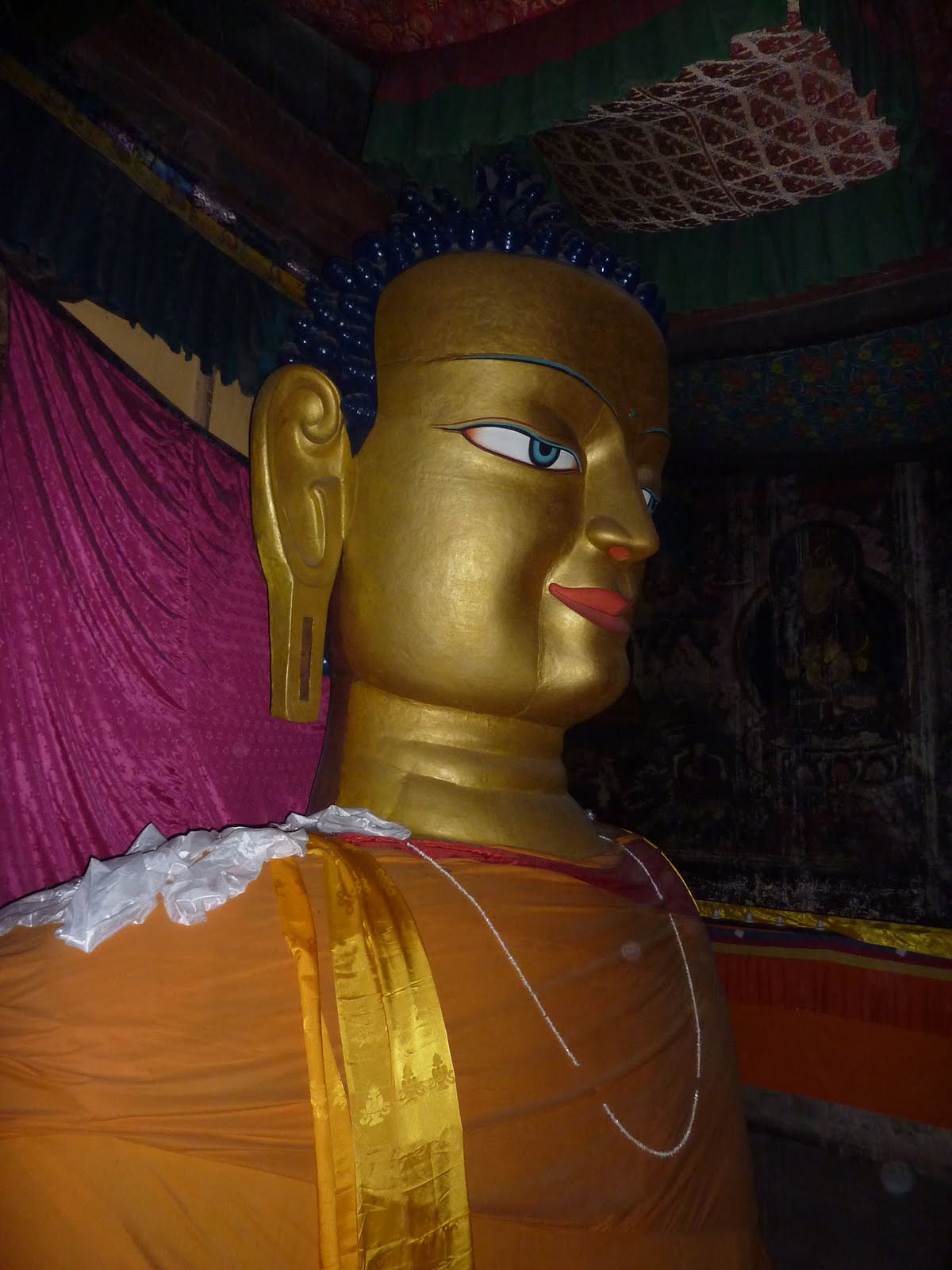
Our first destination on our monastery pilgrimage was the small village of Shey. Only 15 minutes away from Leh, but a world of difference in appearance and in the feeling of instant relaxation and calm we felt upon arriving. The village was the former 12th century capital of Ladakh. Perched on the highest craggy point is the former palace and gompa, famous for its 26-foot high Shakyamuni Buddha statue. The village has one restaurant, one store, and one guest house, in front of which our taxi dropped us off. Standing in the village, we cannot help but be in awe of the fact that we are surrounded by 360 degrees worth of mountains. On one side rugged and barren, dry mountains, etched lines made by fierce Himalayan winds. To the other side of alpinesque snow capped mountains. But like the rest of Ladakh, the inner valley is lush, due to a sacred pond, a former remnant of the palace days.

Our guest house is set off the main road, lined with poplars and grazing cows. The room is basic, kind of dirty, actually, and the 'mother' informs us that the pipes broke last winter, and the plumber has not been by yet. This means that there will be no water, unless you go out to pump it yourself, and no toilet per say, but a dirt room with a hole in the ground that is referred to as the 'local' toilet. But it is the only guest house in town and at least Seth was able to bargain the woman down to a good price, thanks to my many looks of disgust.

At sunset we went to explore the area, walking five minutes up the road, the landscape dramatically changed unto a realm of sand dunes, craggy rocks, and the sight of ancient Ladakh, hundreds of white stupas. Stupas can have different religious properties, they are designed like layered birthday cake, each layer representing a part of the Budddha, thus they can be used for contemplation and prayers. Other times they are the burial site for venerable monks. The second I saw these stupas set amongst the barren sand dunes, my gut instinct said we had entered a burial ground. As we are walking around, in trance by this mysterious landscape of stupas, we begin to hear the sounds of horns, drums and chanting, the ritual sounds of a puja ceremony taking place. Seth of course has to get to the source of these sounds, and goes clamoring through stupas, only to find a single man performing his own personal sadhana practice, and much to his surprise this man is a blond haired westerner.

We later come to meet the man, Josh, who is our age, from Washington, and who for the last 5 years has been attending a University in Kathmandu studying Himalayan-Buddhist Studies. Furthermore we come to find that Seth’s university advisor, Steve Jenkins had taught at this university withing the last couple of years, and Josh had been one of his students. Upon further investigation into Josh, we find out that his teacher in Nepal had sent him on a special pilgrimage into Ladakh, where he was to spend the night and meditate in 108 charnal grounds (cemeteries) before the summer was over. We asked him what number he was on, he said, ´98 and it has been a far-out time. I have definitely seen some hungry ghosts!'

The 26 foot Buddha is housed above the palace, watched over by a little old Ladakhi man, who sleeps in a room next to the Buddha, waiting to collect admission fees from the visitors. We arrived after appropriate visiting hours, but regardless he opened the ancient lock to allow us into the sacred gompa. Each breath this man took and each released was a reverberation of 'om mani padme hum.' His mouth constantly moving in mantra, only pausing to point out certain deities and images to Seth as he circumnavigated the massive Buddha with his camera.
A gale of wind had begun to Blow outside, making the thin glass pane Windows of the gompa rattle and shake. Within a minute the gales became fierce angry wind gods, almost snatching Sea Horse from Seth’s head.

Come bedtime, we are in the guest house and the wind is blowing hard, loud, hot, dry, pushing the poplar trees from vertical to horizontal. The house mother earlier had told us that this was very normal for Shey in the evenings, but this was not normal for two Californians†!
I was wide awake feeling very dried out and disturbed by the intensity of the wind storm, when the sky suddenly starts lighting up. Bright alien flashes of white light where followed by the loudest longest rumbles of thunder I have ever heard-FYI- Seth slept through all of the thunder and lightening…. And then the rains began.

Before I talk about the rain, let me preface this with background on the Ladakhi home. We had noticed this little phenomena in every room we had been in, which is that in every room there is a square hole in the ceiling. We finally figured out that this hole was for the pipe of a wood burning stove, for their long frigid 8 month winters. For a land that averages about 3 inches a year, that hole in the roof never seemed to matter until that night in Shey.

The thunder storm brought rain, and a lot of it, possibly half a years worth of rain, at which point Seth wakes up because it is pouring buckets in our room. Next to our bed. Since I had been up for it all, I had already heard the guest house family downstairs freaking out, trying to cover all the holes in the house, including coming on to the deck attached to our room, which we had noticed earlier had a hole leading right down into their nicely carpeted living room. There is not much to do but laugh when your room is filling up with water, our bed was dry and at least the rains dissipated the dry, relentless winds.

But the story of the storm in not quite over. A couple hours later to say to me in a very calm voice: 'Charlotte there is a bird in our room.' Sure enough there was loud flapping coming from the corner of the room, as a feathered friend had come into our room to take shelter from the storm. Then at about 7 in the morning we were awoken, the storms had stopped, but the entire family was out on our deck setting up a massive plastic tarp. They were banging doors, windows, throwing down large rocks, all to the background noise of crinkling tarp, as from our bed we had front row views of all the action.

The next thing we know they are coming into our room, bringing in plastic chairs and other items that had been on the deck, completely ignoring us. Only in India, would there be no knocking, no apology for their early morning disturbance or for entering our private abode. For in India there is no such thing as private, especially when there is work to be done. In classic Indian style once again, the house mother was extremely surprised when we told her that we would not be staying another night as was originally planned, never mind the fact that we were standing in our room in a large puddle of a rug.




Leaving Leh

It was time to leave Leh. The city was getting under our skin in an unhealthy way. Like any city it is noisy and dirty, but in Leh that is accentuated with the fact that the streets are narrow and village life, meaning a trip downtown, was a car dodging, loud honking, unhappy time. There is this other thing about Leh too. Three months of the year a collective of shop owners from Kashmir take over the streets of Leh with their Pashmina shops. Unlike shops in America, these shops keep all of their goods outdoors rather than in, therefore it is hard to avoid the man outside every store who yells in your face,‘Pashmina, Pashmina Shawl, I have got a good price for you.’ The reality is that the Kashmiris are here in Ladakh for three months, then take their money and go to their shops in Goa for the rest of the year, hurting the local economy, and causing inflation on all the items, making Leh the most expensive place in all of India. Needless to say we were starting to see only the negative side of Leh, with the exception of one thing. Our lovely Ladakhi Guesthouse.

Set back in a rural farming area, surrounded by poplar trees, soft gurgling creeks and poplar lined walkways, our guest house room was a gem at only 150 rps a night (about 3 bucks). Every morning our Ladakhi guest house mother would have fresh mint tea waiting outside our door, I mean what more do I have to say. On our last night in Leh before heading for a tour of the small villages and monasteries of the area, our Ladakhi mother invites us over for a special Ladakhi dinner. Her English is very limited, but her use of facial expressions and hand gestures, including the sounds ‘Oh, Oh, Oh’ have made our communication possible. But that night for dinner, she had asked her daughter Tenzin to join us and translate as she spoke almost perfect English.

The family dining room is filled with 2x4 Tibetan rugs, which cover the low sitting area that covers a third of the room. In front of the rugs are low, brightly colored ornate tables, similar to the ones we have seen the monks sit in front of during Puja ceremonies. These are their dining room tables. There is a large old fashioned wood burning stove in the room, which now has an electric hot plate sitting on top of it. As the daughter explained, ‘The old stove was not used anymore.’ The side walls were covered with antiqued brass teapots, large brass cooking pots and about 50 pieces of assorted metal dishware, all deliberately layed out in an ornamental fashion. The room smelled of musty yak cheese and of fresh mint tea, which was constantly being refilled in glasses in front of us.

Amelie, the word for mother in Ladakhi, serves us plates of fresh momos, which are Tibetan/Ladakhi version of a vegetable dumpling or potsticker, adorned with a type of Ladakhi tomato salsa. The more we eat, the more Amelie tries to fill our plates, and our bellies, regardless of our cries, ‘Please no more, so full.’ Dessert is the famous product of Ladakh, despite the arid desert landscape, they grow the most amazing apricots, which came straight from Amelie’s daughter’s tree.

At the end of the evening, Seth and I were just beaming. Amelie was calling him son, he was trying to hug her, but I don’t think they hug here in Ladakh. Anyways it was a very special dinner. We have been blown away by the love, laughter, kindness and generosity that these people have shown us.


Sunday, August 1, 2010

The Seahorse Montage

It all started while we were stuck in the little trucker stop village of Marhi. Waiting patiently for the dangerous Rohtang Pass to clear, I came upon a little local vendor selling hats. Now, I had been looking for "the hat" since I arrived in India. Due in part to the Jewish mother's voice in my head, warning me of the dangers of excessive sun exposure... And now at 11,000ft , in the little town of Marhi, this "slightly used" brown rimmed hat, glimmering in the mountain light, caught my eye. I tried it on. It was a perfect fit. The two elderly Japanese women next to me were raving about how great it looked on me, and asked if they could take my photo... I took this as a sign. For only 100 rupees, I crossed into a new realm of being - I was now a "hat man." After a warm hat welcome by my friends, we learned that around the rim of the hat was written "Seahorse" repeatedly. With great laughter, we had a new addition to the family - Seahorse.

Now, fast-forward to the small Ladakhi village of Summur, while on the Dalai Lama tour. At the end of the teachings of Day 1, while the stampede was leaving the monastery, I happened to spot out of the corner of my eye... Seahorse! I had to do a double take. Sure enough, sitting in the grass, was a little Ladakhi man, wearing his very own Seahorse hat. Excitedly I pointed him out to Charlotte while I scrambled for the camera..


After that first Seahorse encounter, we began seeing Seahorses everywhere! And each one, was resting on the head of an old Ladakhi man. We quickly discovered that I was rockin' the old Ladakhi man hat. And everywhere we went on the Dalai Tour, Seahorse became a way to connect with the locals - to cross invisible cultural boundaries, and connect the human heart. They loved it! And so did we...

Here my friends, is the Seahorse Montage:


Wednesday, July 28, 2010

The Dalai Lama Sutra

Thus have I heard.

HH the Dalai Lama was dwelling on the Himalayan Valley of Nubra in Ladakh, together with a great community of monks and nuns, lay and village people, and a select group of Westerners. Surrounded by ancient Buddha mountains with pure snow peaks. The recently blessed, hundred-foot Maitraya looks down upon the procession from the Gompa mount. Prayer flags of red, green, yellow, blue, white - representative of the five elements - color the sky, blowing prayers in the gentle winds.

Squished like bugs, we sit roasting in the Himalayan sun, waiting for His arrival. A sea of red; bald monks sizzle like lobsters, waiting to receive the precious buddhadharma. Waiting. Waiting. Cultivating scorching patience - wiggling Westerners get restless. "Put the umbrellas away!" They say, "I can't see!" When there's nothing to see. The Dharma is to be heard. Through a crackling speaker box, an English translation transmits through. The drums and horns sound. Here we go...

A big Dalai Lama smile and bow spreads through the crowd. We return by dropping our ego-minds in three prostrations. Thousands in attendance. The tea blessing begins. Thick, salty, yak butter is served up warm in big bronze pots by monks and Ladakhi women, adorned in their finest garments, deep blue turquoise chunks and big yak wool top hats. Along with the tea is served thick Tibetan bread, made fresh by the village women the night before.

The Dalai Lama raps on about emptiness. Nothing exists from it's own side. Cultivate the wisdom that knows emptiness. Interdependence is the other side of the coin. Perception, logic, ration, epistemology, subject/object, Prasangika Madhyamikya says... Nagarjuna, Chandrakirti, and Shantideva say... bodhicitta! Tongue twisting mouthfulls of Tibetan and Sanskrit, names and texts linger in the dry desert heat.

"Scientists are showing that those who constantly think of 'I' are more at risk of heart attack." The ego-mind is attacking the heart. Thoughts can kill.

The suffering of sentient beings is felt throughout hot, aching, itching, wiggling Western knees and spines. While the mountains sit strong, watching the endless procession in stillness. No wiggling mountains. No itching rocks. Pure Being - at the natural level. The cool snow peaks appear a mirage as giant beads of sweat slide down my brow. The Dalai Lama laughs and all suffering is momentarily ceased.

---

After an incredible week in the small rural villages of the Nubra Valley, on the Dalai Lama tour, drinking yak butter tea, spinning big prayer wheels, photographing big white stupas, eating momos and chow mein, saying Juley all day, taking ice cold bucket baths, living a life a little closer to a Ladakhi, a little closer to the Earth - something amazing happened. On the afternoon of the final day of teaching, HH the Dalai Lama announced he would be granting the Westerners an audience!

With a group of less than a hundred, we rallied through all the Ladakhis, security, and up to the DL's residence. The excitement was so high. The whole week we had felt so blessed to even be there. The Dalai Lama had been giving high teachings and initiations to the local monks and nuns of the Nubra Monasteries. At each one, we were fortunate enough to have a private section, right up front, with an English translation. This made for a rather unique and intimate gathering - a truly special Dharma transmission. And now we were to meet HH up close and personal!

He "lama walked" out to our group, smiling and waving, apparently unshaken by the heat, or the 3 hours of teachings he had just dished, at the end of a long week of teaching - he was not finished yet. In English now, he addressed us as his friends, speaking of the universality of the human heart. After about a fifteen minute dialogue, filled with much laughter, he willingly suggested a photoshoot. Thus our week in the Nubra came to a climactic end, with a meeting with HH the Dalai Lama.


Saturday, July 24, 2010

Juley! We Have Arrived in Leh

After the harrowing journey over the Himalayan mountains, we arrived upon the capitol city of Leh. We came into a dirty bus station at about 11pm, and after 4 days of traveling, we were quickly suckered into the first guest house we were offered. We had no reservations, which is the way it usually works, you get to a place and a guy comes up to you and says, "come look at my house, very nice place." Sometimes it is, but in the case of our first night in Leh, this was not so. I think when we arrived to the guest house it was only a matter of moments before Seth announced to me, "we are leaving in the morning." The first thing we found out was that there was no water, so if you want to bathe they bring you a bucket, which may or may not be warm, and they might not bring the bucket at all!

In the morning our pseudo tour guide, Glenn, announced he had found a much better guest house about 15 minutes away. So Seth and I packed up our stuff in a flash and, still hungover from the bus journey, found ourselves walking through the cobble stone village paths of the real Ladakh - the Ladakh that we had imagined through all the stories and movies we have seen and heard. The new guest house turned out to be a beautiful traditional Ladakh home, white walled, hand made bricks, thatched roof, beautiful green vegetable garden, streams running through and around the property, and my favorite Poplar trees lining it all. Our room is surrounded with big windows, facing in all directions the snow covered Himalayan mountains. Our little Ladakhy mother brings us fresh mint tea in the morning, and there is an actual toilet, unlike most places in the area which just have a hole in the floor.

Check out the picture below of the view from our bathroom!

Heaven. Suddenly the journey here started to feel like a distant memory as we fell in love with the city of Leh.


Here in Ladakh we have learned one word, "Juley" pronounced JOO-LAY. It is one of those amazing words that means: Hello-Goodbye-Thank You- Please-Excuse Me-Peace-and HEY YOU ALMOST RAN ME OVER! We must say Juley at least 100 times a day.

We have spent our days here in Leh in preparation for leaving for the Nubra Valley, which is located in the heart of Ladakh, about 5 hours from where we are. A place that requires permits, tents, bus tickets, and all the usual travel commodities.

Leh has an influx of westerners, and therefore the restaurants offer a selection of Indian, Ladakhy, Chinese and Israeli food, which we partake in, always saying, "Well...this may be the last time we will be able to get a falafel."

The valley that Leh sits in is surrounded by peaks that host an assortment of buildings, from monasteries, peace stupas, old forts, and the famous Leh Palace that was supposed to be the reproduction of the Potala Palace in Lhasa, Tibet.


Before coming here I had read the anthropological studies of the Ladakhy people done by Helena Norberg Hodges, in her book "Ancient Futures" (thank you Daruka). Which was written over 25 years ago, when she had become one of the first Westerners to come to this part of the word. She started an organization called the Ladakhy Woman's Alliance, that supports the self sustainable lifestyle and culture of the people. Everyday this organization shows a documentary film based on "Ancient Futures" which we went to watch one afternoon. You can all probably imagine the themes addressed in the film, a culture completely self-sustainable, producing no waste, strong community, being destroyed by the influx of globalization. People moving from the farm lands of no poverty to live in the dirty ghettos of the "big" city of Leh. Food production no longer local, grains shipped from Southern India, rather than grown in Ladakh.

Really sad, the day we watched the film, I had actually taken an hour walk, with my two girl friends, to buy bus tickets at the the very dirty bus station. Although we were staying in the image of beautiful traditional Ladakh life, to get to the bus station we had to through the nasty, dirty, garbage heap projects of Leh. Shops slanging crap, western paraphernalia, guns, sex and rock and roll, feces everywhere, no fresh water, no vegetable gardens, all in all pretty gross. I was thankful to get back to the other side of town, and to the sound of the streams running past my bedroom window, but a great perspective none the less.

Now off for a five hour journey deeper into the mountains, over the highest road pass in the world! to the very small town of Sumuur, where we will receive two days of teachings from HH the Dalai Lama.


Monday, July 19, 2010

A Journey to Ladakh

I have been trying to write this post now for the past three days. I don't know if it's the altitude, writer's block, or the fact that it is just impossible to translate such an intense experience into mere words (I'm beginning to feel this will be a theme in India - the inability to describe the ineffable). But seriously, our journey to Ladakh was ridiculously out of this world. Both good and bad. Someday I'll take the time and write a longer story about this one, but for now I'm gonna have to keep it brief...

It was supposed to be a "smooth" 2-day bus ride from Manali to Leh. With a overnight stay in the desolate Himalayan town of Keylong to break up the journey, and to help us acclimatize to the high altitude. Leh, the capitol city of Ladakh, is situated at about 14,000 ft high in the Himalayas. Until the last few decades, it was pretty much isolated from the rest of the world. It is one of the highest and driest regions on the planet, only accessible about 3 months - for the rest of the year the valley freezes over, and the few road passes are all snowed in. To reach Ladakh, you must journey up to 17,000 ft, over the second highest road on the planet.

Day 1

Very excited, and with a sangha of friends from the Heart Sutra course at Tushita, including Glen our teacher, and soon to be tour guide and fearless leader, we packed onto the government bus with a few other Westerners and several Indian families. Now, we had already overheard a few broken hearts and horror stories at Manali restaurants, about how the roads had closed due to a recent avalanche. One girl told how their bus had broken down on their way back to Manali and they had to ditch the bus, walk several miles to find horses, ride the horses back up the mountain to gather their gear, and horseback ride all the way back down to Manali - all the way to the table next to us on "date night" at People's restaurant. Char and I looked at each other wide-eyed in agony for these people, but we assured ourselves the road will be clear and safe by tomorrow, nothing like this would happen to us...

Well we didn't have to ride horses. But we would have paid to! The landslide was in full effect when we arrived at the pass on Day 1. As we pulled up to the tiny little trucker stop town of Marhi at 11,000 ft, we could see the blocked pass above, lined with hundreds of jeeps, buses, and trucks, stacked behind each other like red and white dominoes all the way down the mountain switchback road. We had only been on the road for about two hours, and already had been delayed twice. Now we were to "wait it out" until the road cleared. As we gathered for chai and lunch at one of several small dhabas, we learned that there was another problem: a truck had nearly fallen off the cliff and was stuck, half blocking the road. Still we waited...all day... until nightfall, when with sunken heads we all gathered back on the bus and dreadfully headed all the way back down to Manali. Spirits defeated, we were almost back at the Manali bus stop, when ptsssssssss one of the back right tires went out like a kick in the stomach. To add injury to insult, our sister Emily twisted her ankle in the busy street as we were searching for a guest house.

Day 2

The next day we all headed back to the bus stop, a little less enthused, but still optimistic about the road ahead. There was still no word about whether the pass was clear. The government bus office sent their P.R. rep on the bus to give us a big pep talk, a motivational speech ha! To get everyone riled up, "No one is coming back to Manali tonight!!" Shouts and applause from the bus... Those words proved true... but I would have really liked to see what this guy would have had to say, oh about 10 hours later, when we were stuck waiting again in Marhi. He wouldn't have gotten off the bus so easy...

Back in Marhi we waited.... and waited... and waited.... still no word. Ladakh melted further and further into an imaginary realm beyond our reach. The domino line of vehicles was still stuck in pause. By mid-afternoon, the 11,000 ft altitude hit Charlotte and she began to feel uneasy and lightheaded. Everyone was getting restless. There was talk about ditching the bus and walking 5km with our bags over the pass... We learned that some cars had passed through, thinking the landslide was done. One car got slammed by some big rocks. One person died. Tension on the bus was getting high. Some wanted to walk, some wanted to stay the night, others wanted to go back to Manali for fear of sleeping at such high altitude.

We ended up staying the night in Marhi, after waiting around for over 10 hours... with still no promise that the road would be cleared by morning. Some had left the bus, taken a taxi up the hill and walked across the pass into the night. Who knows what lay ahead. We found a "place" to rest for the night. Behind each dhaba restaurant, through the kitchen, was a path through the tiny village to a toilet. So many toilets. We stayed in the toilet village, in a tiny little shack with bunks. Give thanks for sangha, again and again. However that night our sangha grew to include a few tiny hairy little friends. As I lay our sleeping bags on the top bunk, a big rat raced above my head across a wooden pillar. They would multiply throughout the night... But it actually wouldn't have been so bad, except as soon as I lay down for bed, the altitude hit me, hard. My head was throbbing. Tossing and turning, heart pounding, it was incredibly painful. I could barely breathe - I didn't know if I'd make it through the night. I crawled into Child's Pose and focused on my breath. Laying back down into Savasana, I finally drifted asleep... for about 2 hours.

Day 3

We were awaken abruptly, dark and early by Glen at our "window" door, "WE'RE GOING! WE'RE GOING!" Absolutely startled, we jumped out of bed. Banged my head. Char's glasses fell. We could hear the bus engine starting. "WE'RE GOING! WE'RE GOING!" We all ran out to the bus as quick as possible dragging our things behind. No one was on the bus. It was chai time.

Finally on the road again, it took us over five hours just to get through this little pass. The truck was still stuck, but one by one vehicles were being squeezed by. A group of saintly Indian man stood on the edge of the earth all day pushing trucks and buses like ours through the muddy rocks. It was quite a scene. But finally, like a newborn, we pushed through that motha!! After hours of amazing fresh mountain landscape, we made it to Keylong, two days later... Finally, we were making progress. We were told that we would stay at the finest hotel in Keylong. Which in India means we stayed in tents in the front yard of the finest hotel in Keylong. With no showers. We climbed up the river and took a icy cold Himalayan bath.

Day 4

We were back on the bus the next morning, late, at 5am, for what would be the longest most difficult day yet. We had over 250km til Leh. We were tired, weary, excited, and a bit loony. Did I mention this day was long? We covered some of the most amazing land I have ever witnessed. The diversity of the landscape and geology was insane. From the lush green mountains and trees of Manali to rugged stone scapes, dry desert plains, frozen tundra, snow like Siberia, to red rock like the Grand Canyon. It was unbelievable. All in all we drove over 17 hours that day. And I felt every single bump. We were, by the way in the very back of the bus, and could literally feel the road. Numerous times we hit a bump in the road and was sent flying off my seat, slamming my head into the luggage compartment. Once in particular, my head already throbbing from the altitude, I felt my brain do a little jiggle.

But I was really doing fine, until we hit the high pass, 17,000 ft, and stopped for a photo shoot. I began shaking, and shivering, my body weak and cold, I stumbled back onto the bus. Then flushed with hot flashes. Then again cold, hot, cold, and hot...my head was absolutely throbbing. I felt worse than ever. Finally, the little Indian ladies got back on the bus, and we began our descent. I started to feel a little better, but those last four or five hours were so uncomfortably painful. Just about everyone on the bus was looking more and more like death. People were throwing up. Every five minutes an Indian woman would let out a hideous moan, sending shrills down everyone's spine. We were almost there. Beautiful white stupas began appearing through the dark night of the dirty bus windows. I could almost feel the sheets of the guest house bed ahead of me. And then ptsssssssss - deja vu - the same tire went flat like a hospital life-line. We were stuck in the dark somewhere in Ladakh. After an hour or so, the tire was fixed. Back on the bus, we were in Leh in another hour and a half. Like tourist fresh bait, we were swarmed by taxi drivers and guest house owners. Somehow we made it to a bed that night, not the soft down comforter I had dreamed about, more like a wooden plank, but we had arrived.