Wednesday, August 11, 2010

Aftershock in Leh

Aug 8

Housed in the peaceful confines of Thiksey Monastery for the past five days, we really had no idea. I mean, we had an idea, but it was only an idea – rumored facts and tid-bits of information passed on like a children’s game of Telephone in jumbled Ladakhi-English. But this was no child’s game. 150 dead. 300 in Leh and Changlamsar. 500… It was impossible to imagine, we had to see the reality for ourselves. Were our friends in Leh okay? Our guest house? And Amalie, our sweet surrogate Ladakhi mother, and her son Anchuk? And what about our own families? Had news spread internationally??? We needed to find a phone.

We packed up in a hurry, checked out with the monks, and hit the road again – with our rucksacks on our backs and our thumbs out for Leh. After a short walk, we hopped on the back of a tractor with fifteen or so Ladakhi’s and cruised through town along wet muddy roads. We could see and feel the aftermath of the storm. Trees uprooted. Home sunk in. Roads and streams flowing together as one. We jumped off and continued walking. Soon a black SUV stopped alongside the road. We jumped in and got a very fortunate ride all the way to Leh, with a kind group of men who were driving to the hospital to pick up the recently deceased body of a relative. Needless to say, there was room in the car.

On our way we passed by a large military settlement. Hundreds, perhaps thousands of Indian, Pakistani, and Nepalese families lined the streets. With bags packed, they sat waiting in the roasting sun like it was a Delhi train station. We were told that all the migrant workers in Ladakh were being sent home – back to Kashmir, Kathmandu, and Bihar, respectively. The government was boarding plane after plane to get everyone out of Leh as quickly as possible. Driving by the sea of people, the thought occurred to me that Indians must be the most patient people on the planet.

It is interesting though, that all these people are being sent home. Each year they come here in the summer months, during the High season, to earn money off the flood of tourists that pour in from June til September. But now, disaster has struck. The rest of the season will be spent cleaning up the storm, rebuilding houses and repairing peoples’ lives. Not quite lucrative work.

---

The city of Leh is in ruin. Walking through the streets, it looks and feels as if a bomb has gone off. The air is thick, hot and sticky. With rucksacks on our backs, we wear scarves over our faces to prevent the dust from swallowing us whole. Businesses and buildings are nothing but piles of rubble. Entire houses are destroyed. A family gathers around, staring hopelessly at what was once their life. A western toilet, dirty white porcelain sticks out of the debris. Cars are smashed like metal pancakes in a scrapyard. Only a machine could so completely flatten and destroy such an advent on modern technology. But this damage was not performed by the hands of men. This was the unadulterated work of shakti – the pure, raw power of mother nature. Good ol’ Prakrti huffed and puffed and blew the house down.

It is our first time in Ladakh, and the greatest storm in it’s ancient history has sent the people into hysteria. Strange karma. Now over 1,000 people dead, they say. Many more still, injured or missing, but information is scarce and filtered with fear. For the Ladakhi people the flood is not just a natural disaster, but a spiritual one – inflicted by evil spirits. The Leh locals were absolutely spooked. No one would give us a ride anywhere out of pure fear. 1,000 rps? 2,000… 3,000??? It was no use. We found our friends and of course they were okay though. Amelie tells us in Ladakhi, waving her hands, how she was so worried about us. We give her and the family a big hug and embrace.

Emily told us her story. Sleeping in her guesthouse, she was awoken in the middle of the night, not only to the monstrous storm, but worse to the local Ladakhi women screaming, running through the streets. She ran out of bed with a sprained ankle. Everyone was heading for the hills, literally. Hundreds of people set up camps high along the Japanese Peace Stupa, and across the other side of town, above the main bazaar at the old Leh Palace. The whole town was moving, bustling through the night – like ants trying to avoid the wetness, scurrying to the top of the hill.

Cultural Karma or Climate Change? Probably both. No one in Ladakh had seen anything like this before. We walk past the bus stand where had arrived in this desert mountain land only a few weeks before. It is unrecognizable, absolute ruin. We see a big government bus, just like the one we rode in on, smashed up on it’s side like early retirement. The place looks like a war zone. A wall of Mani prayer wheels have been ripped from their humble stands. Small strips of paper prayers in black Tibetan ink splay everywhere, blowing their final blessings into thin air.

The locals despairingly informed us that it was likely that the annual September Ladakhi Festival would not be celebrated this year (another big hit to the local economy). The energy and hysteria in Leh was just too much. The spook had been further stirred by Vedic Astrology. According to the stars, the worst had yet to come. We immediately turned back around for the peaceful gompa gates of Thiksey. Walking through the local villages we can hear the familiar sounds of the monks’ puja. Only now they are being held for the souls of the deceased.


Shelter From the Storm

Aug 6

A quiet sombre mood permeates the monastery grounds. Last night, the second night of a fierce storm (the worst in history), struck the high desert lands of Ladakh. All through the night, the rains poured buckets from the sky, the winds howled, while thunderous lightening shook the valley. Big flashes of white lit up the dark mountain sky. With no power, we watched and listened to the raw power of nature, until the candle burned to completion.
In a place that averages only 3.5 inches of rain annually, no one was prepared. However, upon his arrival in the Nubra Valley, HH the Dalai Lama had confided that the Oracle had prophesied that a great big storm was brewing. The local people said their prayers, made the appropriate offerings to their protector gods, and went on with their lives. For there was work to be done in the kitchen and in the fields. Besides, what else could they do†?
During the middle of the night, the village of Thiksey was abruptly awaken by a torrent flood of high waters, rushing through the streets and into their homes. With no hesitation, the people picked up their essentials, food and blankets, and headed up the hill to the village monastery. All day they have poured in, hundreds of people, men, women and children. It is admirable to witness the level of community and resource the monastery offers the village and its people, as it has functioned traditionally for thousands of years. As we watch the procession of families and possessions pour in, filling all dry empty space, I am reminded of a somewhat similar scene I had witnessed a few years ago in the States…

---

While living in San Diego, during the Spring of 2008, the county burst into California wildfire. Thousands of buildings and homes were destroyed. I recall the government issuing an air health-safety warning, we wore masks through the streets. Not because of the fire per say, but because of the toxic chemicals, the paint from houses, which was being spewed with smoke into the neighboring air. And as we are quickly learning, there are no borders in the sky.

Over one million people were evacuated from their homes with no place to go. A few shelters were set up for the new American refugees, but most were sent to Qualcomm Stadium, home to the San Diego Chargers NFL football team. Like Thiksey monastery, the football stadium opened its doors during the time of crisis to shelter its people. A few friends and I took the local bus over to lend hands. The scene was mad. Thousands and thousands of people, pouring in from all directions. Truckloads of tents, food, and supplies were arriving. Big mountain piles of donated food and clothing were being sorted through in the parking lots by volunteers. We helped young families set up tents to try and get some needed sleep for the night.

California’s Governor, Arnold Schwarzenegger, helicoptered onto the scene to make his routine press appearance. Cameras and people flocked towards to hear his holy words. I recall being surprised by his unproportionally large Ken-doll face, but I don’t remember what he said. I do remember the new which came the following day. The next day at Qualcomm Stadium was a Sunday, a ‘holy’ day for NFL fans, and a scheduled home game for the Chargers. It was decided and announced that the game would not be cancelled. The game would be played. And the thousands of homeless San Diego citizens, many of whom no doubt were die-hard Chargers fans – who had been following their beloved team since they were born, into a family of die-hard Charger fans, who had attended tailgate parties and gone to every game they could afford, every Sunday like it was Church, and who would have no doubt loved to be at this Sunday’s game, were it not for the fact that their house burnt down in flames the night before – yes, these people, along with everyone else, were forced to leave the Stadium, exiled into oblivion, so that their beloved Chargers could maintain dreary hopes of making the playoffs.

---

All of this I am reminded of, as I watch these poor Ladakhis, Indians, and Pakistani’s, endlessly trickle into the gompa courtyard. But here I am struck by an altogether different scene. Not just the obvious dichotomy in locality of a Buddhist monastery versus an NFL football stadium, but the social function of the ‘Church.’ Here in Ladakh, the first born son of every family is sent to monkship at the local monastery, where he will learn to read and receive a proper education. It is supported by the community, and in turn, the monastery nourishes the community, as the center of learning and religious activity. It is a mutual and reciprocal functioning relationship. The kind healthy ecology is made of. And when disaster strikes the village, there is no question or hesitation of where to go, or what to do – like a public school fire-drill, everyone heads for the gompa, safely perched high on top the hill. The monastery opens it’s big Dharma gates to embrace all. Shelter is provided. The school closes, to open its rooms for everyone. Tea is served. Food is fed. A natural sense of oneness and camaraderie is felt throughout the community.
The puja carries on by a few elders, because tradition must. But most of the monks become workers, leaders, and community organizers. Passing by a stream of new arrivals, one monk says to us, ‘We take this very seriously.’ He smiled, ‘But these buildings are very old, and we must be careful with all these people.’

Not only do the local people have an extended home, but we too have a place to stay, a shelter to take refuge. Because we arrived a few days prior, we had secured a clean comfortable room†; with big white walls, high wooden ceiling, big white bed, and large mountain view windows. Just outside our door, families are lined up laying on the hallway grounds. The villagers lay on blankets and mats under gompa awnings and dining room floors. They gather for shelter. circled around big Mani prayer wheels. My heart perturbed by the commotion outside our bedroom, I open the door to offer a small bag of nuts and barley to the women. I cannot help but feel guiltily, but do my best to cultivate compassion. More than anything, I feel gratitude. Grateful to be healthy, safe, and alive - with my beloved in my arms. We received word that many others were not so fortunate. Less than 12 miles away, in Ladakh’s capitol city Leh (where we were staying only two days before), over one-hundred people were announced dead this morning. Many more are injured or missing. Bodies continue to be dug up from the storm ruin. The roads are all closed – the buses destroyed. The water supply has run dry (truly an anomaly after last night’s downpour…), and the power comes and goes in waves.

I hear screams from outside the hallway. But they are only of children playing. Despite the somber mood, there is a sense of festivity in the air. The family is together. The community is strong. The monks’ mothers, brothers, and sisters are here. All generations under one gompa. The toothless grandmothers smile at us as we greet them, ‘Juley!’ The old men waddle around, fingering their rosary beads as they breathe heavily, ‘OM MANI PEMME HUNG’ faster than is Englishly possible. As the late afternoon fades to early evening winds, I look up to the ominous dark grey sky. Thunder begins it’s familiar tumultuous rumble. I feel a few drops of rain splash upon my head.

Thiksey Monastery Puja

Aug 5

Day 3 of the Mandala Puja at Thiksey Monastery . OM AH HUM.
The chanting begins at 6:30am and goes on and on. About fifty monks are in attendance, along with twenty or so Westerners – the tourists, who walk around with their big black lenses, pointing and shooting, click-click, snap-snap, shoving their cameras in the monks’ faces like animals at the zoo. Flash-click-snap. The sign out front reads†: Please no flash photography. The Thiksey puja has become another tourist attraction on the Trail, even our guide book says so. And no surprise really. Its absolutely beautiful. So sacred. A unique experience to be welcomed so openly into the strange and mystical world of Tibetan Buddhism. The gompa walls which surround us are filled with colorful murals of Buddhas and bodhisattvas, fierce protector deities, and the erotic yab-yum images of consort yoga. It’s enough to make any middle-aged Protestant American scream, running for the doors of the confessional.

The influence of Tibet’s primitive Bon religion speaks through the darkened worn images and symbols; it’s evil spirits, animism, ritual, and sacrifice Evident – soaked up by Padmasambhava and the Buddhadharma and transformed into the highly Evolved Vajrayana. The quick path to liberation, starts early. The young monks, seven or eight years of age, pour butter tea and serve big buckets of barley flour to their seniors, who have been chanting these sutras since they were pouring tea themselves. Within these same gompa walls. On these same old cushions. Prostrating, bald heads gracing these same wooden floors, who knows how many times before. These old monks waddle, lama-walking to their seats, are the last of a generation. The last lamas to live and practice the Dharma with little or no contact with the West, or the greater outside world for that matter. No flash photography. No gift shop. No commercials, world-wide-web, or television. Now, when the pretty young Israeli girls step out of the jeeps and into the puja, in their halter tops and spandex, the young monks can’t help but stare. At age twelve or thirteen, the monastic life cannot protect them from their biological inheritance. The fire of their youth, turns the spinning wheels of the lower chakras.

Thiksey monastery is hundreds of years old, these practices, thousands. There so much beauty to be felt in its presence, a transmission of ancient sound passed down through the deep, grunting vibrations of a chanting monks’ melody. Like a timeless river stream, flowing from the Buddha Shakyamuni himself. To listen is to hear the Dharma. To sit together, is to be the Sangha. In this body, in this breath.

But conventional wisdom reveals, I am still human – same too, these monks. They are not so different. Sometimes they are ‘here,’ while I am all the way over ‘there.’ But right now we are both Here. Sitting together, swaying to the melodious rhythm, sipping tea, stirring flour into Tsampa balls with our fingers. They too are tired. Bald heads drop one by one like flies, for a little puja snooze. The young monks appear uninterested, busy chatting and playing, throwing rice grain offerings at each other across the room when the elders aren’t looking. There is a genuine realness about the whole scene. However, this is their life, while I am just visiting. But I guess we’re all just passing through…

The horns blaze, Tibetan clarinets roar, bronze cymbals clash like lightning, the little lamas breathe deep into conch shells, while the deep bass drums pound – the ancient Buddha heart-beat. Deep mountain earth, sounds from another time. Someone must have hit the reset button – the mind clears, empties into silence. Snoozing monks wake. Only three more hours to go.


Shey: The Ancient Capitol of Ladakh

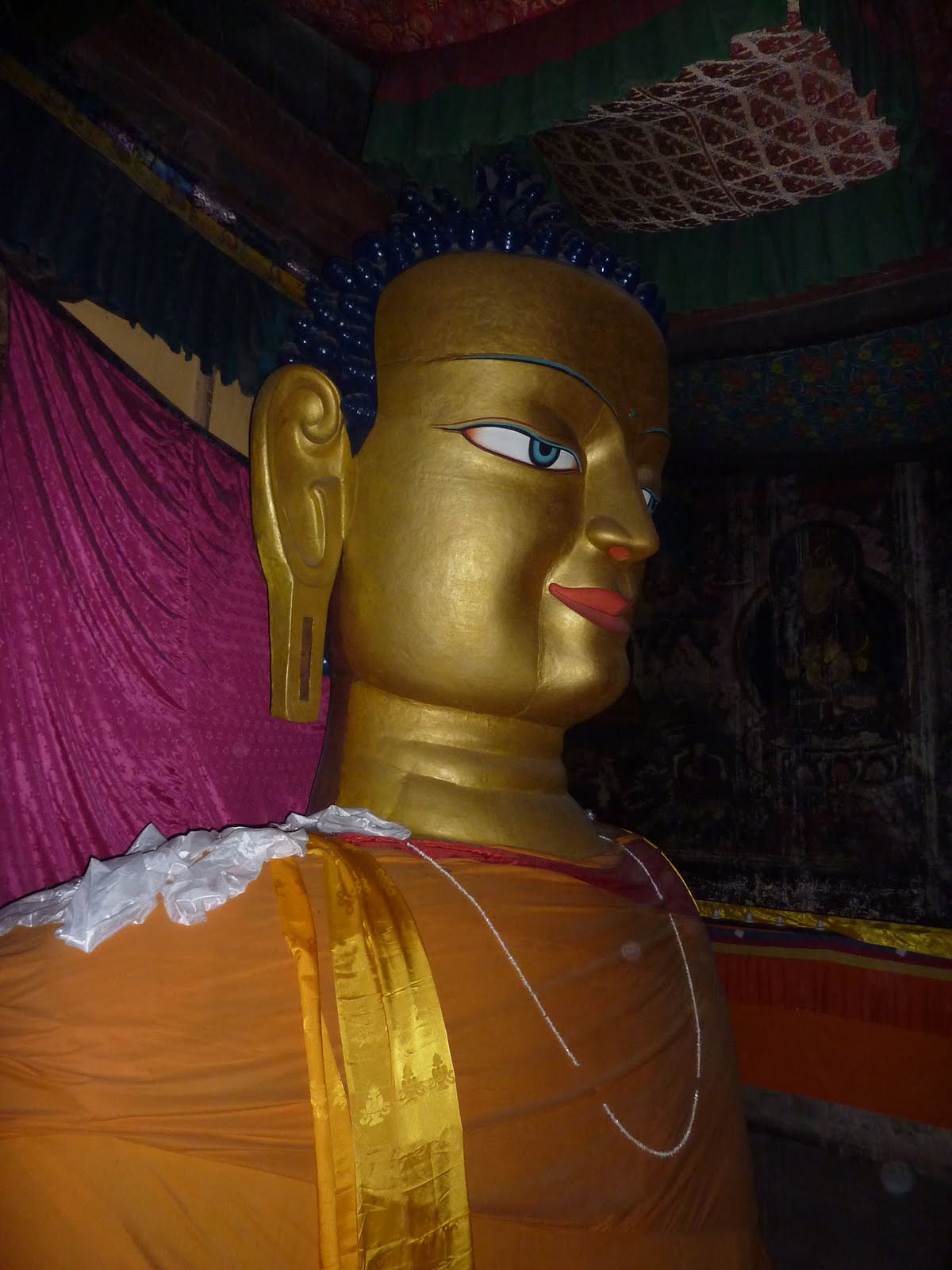
Our first destination on our monastery pilgrimage was the small village of Shey. Only 15 minutes away from Leh, but a world of difference in appearance and in the feeling of instant relaxation and calm we felt upon arriving. The village was the former 12th century capital of Ladakh. Perched on the highest craggy point is the former palace and gompa, famous for its 26-foot high Shakyamuni Buddha statue. The village has one restaurant, one store, and one guest house, in front of which our taxi dropped us off. Standing in the village, we cannot help but be in awe of the fact that we are surrounded by 360 degrees worth of mountains. On one side rugged and barren, dry mountains, etched lines made by fierce Himalayan winds. To the other side of alpinesque snow capped mountains. But like the rest of Ladakh, the inner valley is lush, due to a sacred pond, a former remnant of the palace days.

Our guest house is set off the main road, lined with poplars and grazing cows. The room is basic, kind of dirty, actually, and the 'mother' informs us that the pipes broke last winter, and the plumber has not been by yet. This means that there will be no water, unless you go out to pump it yourself, and no toilet per say, but a dirt room with a hole in the ground that is referred to as the 'local' toilet. But it is the only guest house in town and at least Seth was able to bargain the woman down to a good price, thanks to my many looks of disgust.

At sunset we went to explore the area, walking five minutes up the road, the landscape dramatically changed unto a realm of sand dunes, craggy rocks, and the sight of ancient Ladakh, hundreds of white stupas. Stupas can have different religious properties, they are designed like layered birthday cake, each layer representing a part of the Budddha, thus they can be used for contemplation and prayers. Other times they are the burial site for venerable monks. The second I saw these stupas set amongst the barren sand dunes, my gut instinct said we had entered a burial ground. As we are walking around, in trance by this mysterious landscape of stupas, we begin to hear the sounds of horns, drums and chanting, the ritual sounds of a puja ceremony taking place. Seth of course has to get to the source of these sounds, and goes clamoring through stupas, only to find a single man performing his own personal sadhana practice, and much to his surprise this man is a blond haired westerner.

We later come to meet the man, Josh, who is our age, from Washington, and who for the last 5 years has been attending a University in Kathmandu studying Himalayan-Buddhist Studies. Furthermore we come to find that Seth’s university advisor, Steve Jenkins had taught at this university withing the last couple of years, and Josh had been one of his students. Upon further investigation into Josh, we find out that his teacher in Nepal had sent him on a special pilgrimage into Ladakh, where he was to spend the night and meditate in 108 charnal grounds (cemeteries) before the summer was over. We asked him what number he was on, he said, ´98 and it has been a far-out time. I have definitely seen some hungry ghosts!'

The 26 foot Buddha is housed above the palace, watched over by a little old Ladakhi man, who sleeps in a room next to the Buddha, waiting to collect admission fees from the visitors. We arrived after appropriate visiting hours, but regardless he opened the ancient lock to allow us into the sacred gompa. Each breath this man took and each released was a reverberation of 'om mani padme hum.' His mouth constantly moving in mantra, only pausing to point out certain deities and images to Seth as he circumnavigated the massive Buddha with his camera.
A gale of wind had begun to Blow outside, making the thin glass pane Windows of the gompa rattle and shake. Within a minute the gales became fierce angry wind gods, almost snatching Sea Horse from Seth’s head.

Come bedtime, we are in the guest house and the wind is blowing hard, loud, hot, dry, pushing the poplar trees from vertical to horizontal. The house mother earlier had told us that this was very normal for Shey in the evenings, but this was not normal for two Californians†!
I was wide awake feeling very dried out and disturbed by the intensity of the wind storm, when the sky suddenly starts lighting up. Bright alien flashes of white light where followed by the loudest longest rumbles of thunder I have ever heard-FYI- Seth slept through all of the thunder and lightening…. And then the rains began.

Before I talk about the rain, let me preface this with background on the Ladakhi home. We had noticed this little phenomena in every room we had been in, which is that in every room there is a square hole in the ceiling. We finally figured out that this hole was for the pipe of a wood burning stove, for their long frigid 8 month winters. For a land that averages about 3 inches a year, that hole in the roof never seemed to matter until that night in Shey.

The thunder storm brought rain, and a lot of it, possibly half a years worth of rain, at which point Seth wakes up because it is pouring buckets in our room. Next to our bed. Since I had been up for it all, I had already heard the guest house family downstairs freaking out, trying to cover all the holes in the house, including coming on to the deck attached to our room, which we had noticed earlier had a hole leading right down into their nicely carpeted living room. There is not much to do but laugh when your room is filling up with water, our bed was dry and at least the rains dissipated the dry, relentless winds.

But the story of the storm in not quite over. A couple hours later to say to me in a very calm voice: 'Charlotte there is a bird in our room.' Sure enough there was loud flapping coming from the corner of the room, as a feathered friend had come into our room to take shelter from the storm. Then at about 7 in the morning we were awoken, the storms had stopped, but the entire family was out on our deck setting up a massive plastic tarp. They were banging doors, windows, throwing down large rocks, all to the background noise of crinkling tarp, as from our bed we had front row views of all the action.

The next thing we know they are coming into our room, bringing in plastic chairs and other items that had been on the deck, completely ignoring us. Only in India, would there be no knocking, no apology for their early morning disturbance or for entering our private abode. For in India there is no such thing as private, especially when there is work to be done. In classic Indian style once again, the house mother was extremely surprised when we told her that we would not be staying another night as was originally planned, never mind the fact that we were standing in our room in a large puddle of a rug.


Leaving Leh

It was time to leave Leh. The city was getting under our skin in an unhealthy way. Like any city it is noisy and dirty, but in Leh that is accentuated with the fact that the streets are narrow and village life, meaning a trip downtown, was a car dodging, loud honking, unhappy time. There is this other thing about Leh too. Three months of the year a collective of shop owners from Kashmir take over the streets of Leh with their Pashmina shops. Unlike shops in America, these shops keep all of their goods outdoors rather than in, therefore it is hard to avoid the man outside every store who yells in your face,‘Pashmina, Pashmina Shawl, I have got a good price for you.’ The reality is that the Kashmiris are here in Ladakh for three months, then take their money and go to their shops in Goa for the rest of the year, hurting the local economy, and causing inflation on all the items, making Leh the most expensive place in all of India. Needless to say we were starting to see only the negative side of Leh, with the exception of one thing. Our lovely Ladakhi Guesthouse.

Set back in a rural farming area, surrounded by poplar trees, soft gurgling creeks and poplar lined walkways, our guest house room was a gem at only 150 rps a night (about 3 bucks). Every morning our Ladakhi guest house mother would have fresh mint tea waiting outside our door, I mean what more do I have to say. On our last night in Leh before heading for a tour of the small villages and monasteries of the area, our Ladakhi mother invites us over for a special Ladakhi dinner. Her English is very limited, but her use of facial expressions and hand gestures, including the sounds ‘Oh, Oh, Oh’ have made our communication possible. But that night for dinner, she had asked her daughter Tenzin to join us and translate as she spoke almost perfect English.

The family dining room is filled with 2x4 Tibetan rugs, which cover the low sitting area that covers a third of the room. In front of the rugs are low, brightly colored ornate tables, similar to the ones we have seen the monks sit in front of during Puja ceremonies. These are their dining room tables. There is a large old fashioned wood burning stove in the room, which now has an electric hot plate sitting on top of it. As the daughter explained, ‘The old stove was not used anymore.’ The side walls were covered with antiqued brass teapots, large brass cooking pots and about 50 pieces of assorted metal dishware, all deliberately layed out in an ornamental fashion. The room smelled of musty yak cheese and of fresh mint tea, which was constantly being refilled in glasses in front of us.

Amelie, the word for mother in Ladakhi, serves us plates of fresh momos, which are Tibetan/Ladakhi version of a vegetable dumpling or potsticker, adorned with a type of Ladakhi tomato salsa. The more we eat, the more Amelie tries to fill our plates, and our bellies, regardless of our cries, ‘Please no more, so full.’ Dessert is the famous product of Ladakh, despite the arid desert landscape, they grow the most amazing apricots, which came straight from Amelie’s daughter’s tree.

At the end of the evening, Seth and I were just beaming. Amelie was calling him son, he was trying to hug her, but I don’t think they hug here in Ladakh. Anyways it was a very special dinner. We have been blown away by the love, laughter, kindness and generosity that these people have shown us.


Sunday, August 1, 2010

The Seahorse Montage

It all started while we were stuck in the little trucker stop village of Marhi. Waiting patiently for the dangerous Rohtang Pass to clear, I came upon a little local vendor selling hats. Now, I had been looking for "the hat" since I arrived in India. Due in part to the Jewish mother's voice in my head, warning me of the dangers of excessive sun exposure... And now at 11,000ft , in the little town of Marhi, this "slightly used" brown rimmed hat, glimmering in the mountain light, caught my eye. I tried it on. It was a perfect fit. The two elderly Japanese women next to me were raving about how great it looked on me, and asked if they could take my photo... I took this as a sign. For only 100 rupees, I crossed into a new realm of being - I was now a "hat man." After a warm hat welcome by my friends, we learned that around the rim of the hat was written "Seahorse" repeatedly. With great laughter, we had a new addition to the family - Seahorse.

Now, fast-forward to the small Ladakhi village of Summur, while on the Dalai Lama tour. At the end of the teachings of Day 1, while the stampede was leaving the monastery, I happened to spot out of the corner of my eye... Seahorse! I had to do a double take. Sure enough, sitting in the grass, was a little Ladakhi man, wearing his very own Seahorse hat. Excitedly I pointed him out to Charlotte while I scrambled for the camera..


After that first Seahorse encounter, we began seeing Seahorses everywhere! And each one, was resting on the head of an old Ladakhi man. We quickly discovered that I was rockin' the old Ladakhi man hat. And everywhere we went on the Dalai Tour, Seahorse became a way to connect with the locals - to cross invisible cultural boundaries, and connect the human heart. They loved it! And so did we...

Here my friends, is the Seahorse Montage:


Wednesday, July 28, 2010

The Dalai Lama Sutra

Thus have I heard.

HH the Dalai Lama was dwelling on the Himalayan Valley of Nubra in Ladakh, together with a great community of monks and nuns, lay and village people, and a select group of Westerners. Surrounded by ancient Buddha mountains with pure snow peaks. The recently blessed, hundred-foot Maitraya looks down upon the procession from the Gompa mount. Prayer flags of red, green, yellow, blue, white - representative of the five elements - color the sky, blowing prayers in the gentle winds.

Squished like bugs, we sit roasting in the Himalayan sun, waiting for His arrival. A sea of red; bald monks sizzle like lobsters, waiting to receive the precious buddhadharma. Waiting. Waiting. Cultivating scorching patience - wiggling Westerners get restless. "Put the umbrellas away!" They say, "I can't see!" When there's nothing to see. The Dharma is to be heard. Through a crackling speaker box, an English translation transmits through. The drums and horns sound. Here we go...

A big Dalai Lama smile and bow spreads through the crowd. We return by dropping our ego-minds in three prostrations. Thousands in attendance. The tea blessing begins. Thick, salty, yak butter is served up warm in big bronze pots by monks and Ladakhi women, adorned in their finest garments, deep blue turquoise chunks and big yak wool top hats. Along with the tea is served thick Tibetan bread, made fresh by the village women the night before.

The Dalai Lama raps on about emptiness. Nothing exists from it's own side. Cultivate the wisdom that knows emptiness. Interdependence is the other side of the coin. Perception, logic, ration, epistemology, subject/object, Prasangika Madhyamikya says... Nagarjuna, Chandrakirti, and Shantideva say... bodhicitta! Tongue twisting mouthfulls of Tibetan and Sanskrit, names and texts linger in the dry desert heat.

"Scientists are showing that those who constantly think of 'I' are more at risk of heart attack." The ego-mind is attacking the heart. Thoughts can kill.

The suffering of sentient beings is felt throughout hot, aching, itching, wiggling Western knees and spines. While the mountains sit strong, watching the endless procession in stillness. No wiggling mountains. No itching rocks. Pure Being - at the natural level. The cool snow peaks appear a mirage as giant beads of sweat slide down my brow. The Dalai Lama laughs and all suffering is momentarily ceased.

---

After an incredible week in the small rural villages of the Nubra Valley, on the Dalai Lama tour, drinking yak butter tea, spinning big prayer wheels, photographing big white stupas, eating momos and chow mein, saying Juley all day, taking ice cold bucket baths, living a life a little closer to a Ladakhi, a little closer to the Earth - something amazing happened. On the afternoon of the final day of teaching, HH the Dalai Lama announced he would be granting the Westerners an audience!

With a group of less than a hundred, we rallied through all the Ladakhis, security, and up to the DL's residence. The excitement was so high. The whole week we had felt so blessed to even be there. The Dalai Lama had been giving high teachings and initiations to the local monks and nuns of the Nubra Monasteries. At each one, we were fortunate enough to have a private section, right up front, with an English translation. This made for a rather unique and intimate gathering - a truly special Dharma transmission. And now we were to meet HH up close and personal!

He "lama walked" out to our group, smiling and waving, apparently unshaken by the heat, or the 3 hours of teachings he had just dished, at the end of a long week of teaching - he was not finished yet. In English now, he addressed us as his friends, speaking of the universality of the human heart. After about a fifteen minute dialogue, filled with much laughter, he willingly suggested a photoshoot. Thus our week in the Nubra came to a climactic end, with a meeting with HH the Dalai Lama.